202 LOURDES...
- Apr 19
- 3 min read
While working out our route, we realised that we kinda go past Lourdes and decided to make our own pilgrimage. But what do we know about the place beyond the fact that coachloads of Christians made the trip there from Liverpool in the 80s?
Lourdes is a small town of around 14,000 people nestled in the foothills of the Pyrenees in south-west France. It sits alongside the Gave de Pau river, with mountains rising dramatically around it. Despite its modest size, it receives around 5–6 million visitors a year, making it one of the most visited places in France and one of the most important Catholic pilgrimage sites in the world.
The Apparitions
Everything centres on events in 1858, when a 14-year-old local girl, Bernadette Soubirous, reported 18 apparitions of the Virgin Mary in a grotto (the Grotte de Massabielle) on the edge of town. During one of these apparitions, a spring emerged from the ground. The Catholic Church formally recognised the apparitions in 1862, and Bernadette was eventually canonised as a saint in 1933. The spring still flows today, and its water is considered miraculous by believers.
The Sanctuary
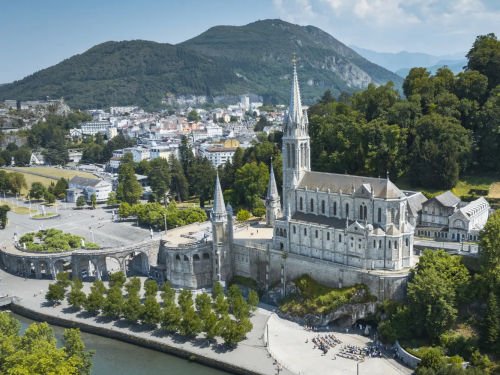
The religious complex - the Sanctuaire Notre-Dame de Lourdes - is enormous and genuinely impressive architecturally, even from a secular perspective. It includes:
The Grotte de Massabielle - the original cave, the emotional heart of the whole site, where pilgrims queue to touch the rock and collect spring water
The Basilique de l'Immaculée Conception - perched dramatically on the rock above the grotto
The Basilique Notre-Dame du Rosaire - a grand Romanesque-Byzantine structure below
The Basilique Saint-Pie X - an underground church built in 1958, one of the largest in the world, capable of holding 25,000 people
The Esplanade des Processions - a vast open space used for the famous candlelight processions held every evening during the pilgrimage season.
The Sick and the Miraculous
A core part of Lourdes is the tradition of the sick coming to seek healing. The baths fed by spring water are a central ritual - pilgrims are immersed in them. The Catholic Church has formally recognised 70 miraculous cures attributed to Lourdes over the decades, verified through a rigorous medical investigation process. Many millions more come simply in hope or faith.
The Town Itself
Here's where it gets a bit jarring: the town surrounding the sanctuary is densely packed with hotels (it has more hotel beds per capita than anywhere in France outside Paris) and souvenir shops selling every conceivable religious trinket - plastic Virgin Mary bottles filled with holy water, rosaries, candles, figurines. It can feel overwhelming and commercial.
But step into the sanctuary grounds, and the atmosphere shifts completely - it's genuinely moving, regardless of your beliefs, to see so many people there in such raw hope.
There's also a medieval castle (the Château Fort) overlooking the town, which houses a Pyrenean folklore museum and offers great views.
The Setting
The mountain scenery around Lourdes is spectacular. The Pyrenees proper are right on the doorstep - Cauterets, Gavarnie (with its famous cirque and waterfall), and the Parc National des Pyrénées are all within easy reach, making Lourdes a potential base for walkers and nature lovers too.
Summary
Lourdes is a small town that became one of the world's most significant Catholic pilgrimage sites and today attracts 5-6 million visitors a year, drawn by faith, hope for healing, or simple curiosity, to a vast sanctuary complex of basilicas, the original grotto, and open-air processional spaces.


Looking forward to my Virgin Mary Water Bottle. We should have a competition who can find the most tackiest gift...